Sunday, 23 September 2012

India ranks 7th in corporate governance in Asia-Pacific

New Delhi: India has been ranked in the seventh place in terms of corporate governance score in Asia Pacific region, says a report by global brokerage firm CLSA.

According to the CLSA Corporate Governance Watch 2012 list, produced in collaboration with the Asian Corporate Governance Association, India's corporate governance score has improved by 3 percentage points but ranking has remained the same.

"This is not due to a lack of awareness by the regulators, but rather a piecemeal approach to reform and a lame duck government unable to do anything meaningful given infighting among its allies," ACGA Research Director Sharmila Gopinath said in the report.

Among the market rankings, Singapore was at the top in 2012 followed by Hong Kong and Thailand in the second and third position respectively. In the fourth position there is a tie between Japan and Malaysia, the report said.

Others in the top include Taiwan at the 6th place, followed by India (7th), Korea (8th), China (9th), Philippines (10th) and Indonesia (11th).

The report which analysed as many as 864 listed companies across Asia-Pacific markets, including Japanese and Australian firms, said that Infosys was the only Indian company that was featured in the top 20 corporate governance large caps.

Moreover, there were just five Indian companies which got featured in the top 50 league table. Besides, Infosys the other four include HUL, Wipro, Titan Industries and Yes Bank.

"Despite efforts made by the corporate sector and individual regulators to raise corporate governance standards, these mostly fail to address core governance issues such as accounting standards, the regulation of auditors and obstacles to voting for investors who are unable to attend company meetings," Gopinath added.

The report, entitled "Tremors and cracks", noted that cracks in Asian corporate governance have become more apparent with corporate scores slipping since the previous CG Watch report was issued in 2010.

Investors have faced issues ranging from relatively minor corporate transgressions to growing concerns about the reliability of financial statements and, at the extreme, outright fraud.

"Corporate governance is largely about checks and balance," CLSA Head of Asia Research Amar Gill said in a statement, adding that "Investors will need to swerve and get a tighter grip when dealing with the cracks in governance and the tremors in Asian investing."

Five Indian Americans among Forbes 400 richest

WASHINGTON: Five Indian-Americans figure in the Forbes magazine's annual list of the richest people in America with Microsoft Corp chairman Bill Gates retaining his top spot with $66 billion, up $7 billion from 2011.
He is followed by Berkshire Hathaway Inc.'s Warren Buffett (No. 2) with $46 billion, also up $7 billion from last year, and Oracle Corp's Larry Ellison (No. 3) with $41 billion, up $8 billion - and the biggest dollar gainer this year.

Facebook founder Mark Zuckerberg has been pushed down in the rankings to the no. 36 spot with his estimated net worth falling by about $8 billion to $9.4 billion since Facebook went public in May.
The Indian-Americans' list is topped by Bharat Desai and family with a net worth of $2 billion in the 239th place. Kenya-born Bharat Desai started as a programmer for Tata Consultancy Services, only to leave the company four years later to start Syntel with his wife.
Next comes Romesh T Wadhwani (No. 250), founder and chairman, Symphony Technology Group, with a net worth of $1.9 billion. Landing in the US with only a few dollars in his pocket, he developed business software firm Aspect Development. Today his portfolio includes more than 10 different enterprise software companies.
Third on the Indian-American list is Kavitark Ram Shriram (No. 298), managing partner, Sherpalo Ventures, with a net worth of $1.6 billion. He was one of the first people to write a check to Google cofounders Sergey Brin and Larry Page in 1998.
Next comes Indian-born Manoj Bhargava (No. 311) with a net worth of $1.5 billion. His two-ounce caffeine and vitamin elixir, 5-Hour Energy, promises to keep users alert without crashing -- and claims a 90 per cent-plus market share in the energy shot sector
Last on the Indian-American list is Venture capitalist Vinod Khosla (No. 328) with a net worth of $1.4 billion. With a firm belief that the future lies in developing cleaner energy sources, the Khosla Ventures founder was a big backer of biofuel producers Kior and Gevo, both of which went public in 2011, according to Forbes.

India successfully test-fired its Indigenously built Agni-IV Missile

 India on 19 September 2012 test fired its nuclear-capable surface-to-surface Agni-IV missile from Wheeler Island, off the Odisha Coast. Fitted with composite rocket motor technology, the missile was test fired from the road mobile launcher. The full range of the missile is 4000 kilometer. The launch was declared to be successful after the missile succeeded in hitting the pre-decided target after taking a flight of 20 minute at an altitude of about 800 kilometer in the atmosphere at a roasting temperature of about 3000°C. The support of Micro Navigation System (MINGS) along with the Ring Laser Gyro based Inertial Navigation System (RINS) ensured the two digit perfection in making the missile reach its target.
The 20 meter long, 1.5 meter broad and 17 ton in weight, is capable of carrying about 1000 kilogram of explosives along with it. Light in weight, this missile is fitted with two stage solid propulsion with a payload for re-entry into the heat shield. One of its kinds, Agni-IV Missile India’s first indigenously developed ballistic missile is embedded with 5th Generation on Board Computer state-of-the-art Avionics and a finely distributed architecture, which allows correction and guidance during in-flight disturbances.
This missile is a proof of India’s quantum jump for in relation to Missile Technology. The long range ballistic missile was designed and developed by the DRDO (Defence Research and Development Organization). This entire operation of the launch was guided to by the Project Director, Smt. Tessy Thomas, along with a team of scientists.
Wheeler Island and Chandipur are the two missile launching and testing stations of India. Both long range and short range ballistic missiles are test-fired from the two stations.

Endangered Armadillo Named Mascot of 2014 Soccer World Cup

Endangered Armadillo Named Mascot of 2014 Soccer World Cup
This week, the International Federation of Association Football (FIFA) named the Brazilian three-banded armadillo as the next World Cup mascot. The endangered animal, represented in cartoon form, will feature prominently in the branding images for the 2014 event, taking place in Brazil.
As reported in Scientific American, the three-banded armadillo (Tolypeutes tricinctus) is classified as being “vulnerable to extinction.” Once common in the savannahs of Brazil, the armadillo has lost much of its natural habitat to cattle ranches and soybean plantations. The armadillo is also disappearing because of subsistence hunting. An article published last month in Biological Conservation predicts there will no suitable habitats for the three-banded armadillo by 2050, and the authors behind the paper call for the creation of new preserves for the animal.
With the mascot decision, FIFA hopes to increase awareness of the armadillo’s possible extinction, and with the world watching, the event will emphasize the importance of conservation and ecology.
FIFA has created a website for fans to learn more about unnamed mascot. The armadillo says that its blue shell represents “the natural beauty of Brazil that I am so committed to protecting. The blue tones represent the sky and clear waters in and around Brazil, which are full of life.” The site goes on to explain that this species belongs to one of only two armadillo species that can roll up into a nearly impenetrable ball.
Although there may be doubt as to whether the mascot can truly make a difference in saving the species, the mascot is already drawing attention. Brazilian fans are unhappy with the potential names FIFA has selected for the mascot, reports Sports Illustrated. The names, Amijubi, Fuleco and Zuzeco, are a mix of Brazilian words for friendship, joy, football, blue, and ecology

SBI cuts prime lending rate by 0.25 per cent

Sep 23, 

The State Bank of India, SBI has announced a reduction in lending rates by 0.25 per cent for those who availed loans before July 2010. The bank's new benchmark prime lending rate, BPLR has been set at 14.50 per cent. The new rate will be effective from September 27.

Earlier on September 18, the SBI had cut the minimum lending, or base rate, by a similar percentage on RBI's cues. The RBI had cut the Cash Reserve Ratio a day earlier by 0.25 per cent to 4.5 per cent

.

Karnataka HC stays 2yrs ban on Mahesh Bhupathi, Rohan Bopanna

Sep 22
The Karnataka High Court has stayed the ban on Mahesh Bhupathi and Rohan Bopanna imposed by the All India Tennnis Association. Justice Mohan Shanthanagoudar pronounced the interim stay on the ban after hearing the petition filed by both the players. The court has also sent a notice to AITA about the stay order, and said that they can reply to the same.

The Tennis Association had not selected them to represent the country in any capacity over the next two years for their refusal to partner Leander Paes in this year’s London Olympics.

World Veteran Wrestling C’ship : Kartar Singh wins in 97 kg category


Sep 22
Indian Wrestler Kartar Singh has created history by winning the title in 97 kilogram category for the 16th time in the World Veteran Wrestling Championship, presently on at Budhapest, Hungary.

Office Secretary of Punjab Wrestling Association, Pawan Kumar has informed that Kartar Singh won the title by defeating wrestler J. Detmar of Austria in just 2.20 minutes. Padamshri Kartar Singh, who is presently serving as Inspector General in Punjab Police has represented India four consecutive times in Olympics. He has won two Golds and One Silver in Asian Games also.

Sept 14- HINDI DIVAS

Amritsar: Various institutions including schools and banks here celebrated Hindi Diwas with great fervor on Friday. The staff and students of Spring Dale Senior School, celebrated Hindi Diwas by showcasing cultural programmes, poetry recitation and plays marked the celebration organized in the school premises.
"Hindi is our mother tongue. It is a scientific language. In our thirst for exploring new horizons of knowledge and learning new languages, we should not forget our mother tongue," was the message given by students of the school. Rajiv Kumar Sharma, Principal of school informed students that on September 14, 1949, the Constituent Assembly of India unanimously resolved that Hindi would be the national language of India.

"At the recommendation of the Committee on National Language, September 14 is observed as Hindi Diwas annually in the entire country," he added. Branch Manager , Union Bank of India, Majith Mandi said they also held a special function in bank and encouraged their staff and clients to use Hindi language.
Meanwhile National Cadets Corps Naval Unit at Khalsa College celebrated the Environment Week in which hundreds of saplings were planted and talks were held on the need of saving environment through such kinds of 'green initiative'. Principal of the College, Dr.Daljit Singh emphasized on planting more and more trees and appreciated the drive undertaken by the NCC.

New species 'blind-snake' found near Amazon river-bed

New species 'blind-snake' found near Amazon river-bed
In an exciting new discovery, biologists have identified six unattractive blind snakes each a meter long at the bottom of a river-bed in Brazil. Engineers working on hydroelectric dam in Rondonia on the Madeira river connected to the Amazon, found this unique creature christened 'atretochoana eiselti', the 'Daily Mail' reported.
The creature neither has eyes nor colorful scales like other snakes, and scientists believe it is closely related to salamanders and frogs family. "Of the six we collected, one died, three were released back into the wild and another two were kept for studies," Biologist Julian Tupan was quoted as saying by the paper Found near the mouth of Amazon river, this snake-like reptile survives in warm and fast-flowing water, and scientists confirmed that this rare creature has only been spotted sporadically since it was first spotted in 1968.
"Despite looking like snakes, they aren't reptiles and are more closely related to salamanders and frogs," he confirmed.
It was first discovered in South America in 1968, but was only discovered on the island of Mosquiro last year. "We think the animal breathes through its skin, and probably feeds on small fish and worms, but there is still nothing proven," Tupan said.

Film 'Barfi' nominated for Oscars


Sep 23
Ranbir Kapoor and Priyanka Chopra starrer Hindi film - Barfi has been nominated as Indian's entry to the Oscars next year in the foreign film category. A love story of a deaf and mute boy set in the fairy-tale world of 1970s Darjeeling has been directed by Anurag Basu. The story revolves around Barfi, a poor but lovable deaf and mute boy, who lives a happy life despite his disability. Secretory General of Film Federation of India, Supran Sen said, Barfi beat 19 other films to represent India at the Oscars. Kahaani, Gangs of Wasseypur Part I and II, Gattu, Jalpari and Dirty Picture were among those short listed for the nomination.

Experessing happiness over the development, lead actor of Barfi, Ranbir Kapoor said it was due to team effort. He said, the movie has still to cover much distance before getting into the final round. Only three films --Mehboob Khan's Mother India, Mira Nair's Salam Bombay' and Aamir Khan starrer Lagaan-- from India have managed to get to the final round of Oscar nominations so far. The 85th Academy Awards will take place on February 24, 2013.

BSNL launches India's first High quality Video Call Office in Ahmedabad

Bharat Sanchar Nigam Limited (BSNL) has launched India's first High quality Video Call Office (VCO) in Ahmedabad. With this launch, the BSNL has become the first Telecom Service Provider in the country to take such an initiative to offer high quality Video calling service to the common man.

Google emerges as world's most attractive employer

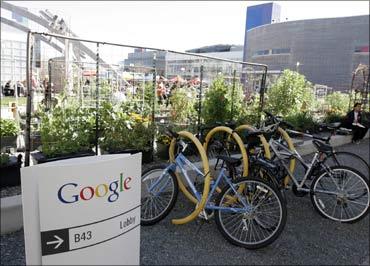
Employees use community bikes to travel around Google headquarters in Mountain View, California.
Google continues to be a hot favourite for career seekers as the company has emerged as the world's most attractive employer, for the fourth consecutive year, says a survey.
According to global employer branding firm Universum's global talent attraction index 'The World's Most Attractive Employers 2012', Google has retained the top position in both categories -- business and engineering -- for the fourth year in a row.

Saturday, 22 September 2012

Hindu Marriage Act in Bangladesh

Aiming to provide legal and social protection to Hindu women from marriage-related cheating, the Bangladesh Parliament has passed the Hindu marriage registration law.
Passed on September 18, the law, first of its kind, has kept the provision of marriage registration optional. The mover of the bill, Qamrul Islam, State Minister for Law, Justice and parliamentary Affairs, said the government framed the act in the absence of any such regulation.
The ‘Hindu Marriage Registration Bill-2012’ authorises government authorities to appoint a Hindu Marriage Registrar at every ward and upzilla across the country. The registrar will not register marriage of a woman below 18 years of age and a man under 21 years.

Goa to shut down mines polluting Selaulim dam

The Goa Government has finally resolved to shut down the mines pouring manganese and iron ore in the Selaulim reservoir, the source of potable water for 55 per cent of the State’s population.
The State will have to shut down the mines operating within the river zone of Selaulim dam, Chief Minister Manohar Parrikar told presspersons yesterday.
“We have to stop all mines pouring in material (iron ore and manganese) in Selaulim reservoir,” Parrikar said.
Situated about 100 km south of Panaji in Sanguem taluka, Selaulim dam has 19 mining leases operating within a few kilometers of its periphery.
These mines were permitted based on the wrong facts provided to get environment clearances (from the Union Environment and Forest Ministry), he said adding that they have dumped the ore along the Selaulim dam, which is washed in the reservoir.
“Our report indicates at least 15 feet of the usage section of the storage is already filled with mud, that is more serious,” the Chief Minister conceded.
Recently, the manganese content in Selaulim water had reached alarming levels. The state PWD had admitted that it was six times higher than permissible levels.
Parrikar said although manganese content in the reservoir has increased, there is nothing to worry about.
“All manganese compounds are not soluble in water and though the content is there, it is free floating,” he said.
“The chemical manganese which can be absorbed in the stomach is within control,” Parrikar added.
Environmentalists in the State claim they had warned it about the serious effect of the mining operation on Selaulim dam some years back.
Environmentalist Ramesh Gawas said the situation at the reservoir has turned from bad to worse, with illegal mines mushrooming around it.
Incidentally, the area around the dam is a part of the Netravali wildlife sanctuary, where mining has to be completely banned.
The Justice M. B. Shah commission, a judicial panel which has done an extensive study of Goa’s iron ore industry, said they have identified three mines around the Selaulim dam area covering 83 hectares, operating since 2003 and working without valid mining leases.

IRDA issues draft IPO norms for general insurance companies

General insurance companies will be allowed to tap the capital market only if they have completed 10 years in business. Also, they need to get prior approval from the insurance regulatory.
“No general insurance company shall approach SEBI (Securities and Exchange Board of India) for public issue of shares and for any subsequent issue, by whatsoever name called, under the ICDR (Issue of Capital and Disclosure Requirements) regulations without the specific previous written approval of the authority concerned,’’ said the Insurance Regulatory and Development Authority (IRDA) in its draft guidelines for IPO (initial public offer) by general insurance companies. Titled the “IRDA (Issuance of Capital by General Insurance Companies) Regulations, 2012’’, these will come into force on the date of their publication in the official gazette.
The guidelines will cover divestment by promoters either through the issue of capital under ICDR Regulations or via divestment of equity by one or more of the promoters through a public offer for sale under the ICDR Regulations.
According to the draft guidelines, the approval granted by IRDA for an IPO will have a validity of one year. The applicant company has to file the draft red herring prospectus with the SEBI within that one year.
The IRDA will also “reserve the right not to accord its approval if, in its opinion, the applicant company is not compliant with the regulatory framework; or where it may be detrimental to the interest of the policy-holders; or it may not be in the interest of the insurance business in the country.”
While granting approval for the IPO, the IRDA will consider the financial health, the regulatory records, IPO proposal per se, the capital structure post-issue and the purpose of capital-raising programme of the applicant company.
The IRDA will also prescribe the lock-in period for the promoters from the date of allotment of shares. Also, the insurance regulator will also specify the extent of promoters’ dilution, and the share allotment to foreign investors. The draft guidelines also prescribe additional disclosures by the applicant company in the prospectus and offer documents. These are risk factors specific to the insurance business.
The insurance regulator has asked the general insurance companies to come out with their views on the draft guidelines by the end of this month.

DEITY unveils internet search engine based on Indian languages

 Sandhan can find response to queries on website in Bengali, Hindi, Marathi, Tamil and Telugu.
The search engine user has the facility to submit a query either with the help of in-script keyboard or phonetic keyboard and in case of in-script keyboard, user can type using the keyboard or onscreen keyboard can be used to submit a query to the system, the statement said.
It has been developed by 120 researchers of 12 institutions over a period of 6 years led by Pushpak Bhattacharya under the supervision of Technology Development for Indian Languages at DEITY, the statement said.
"It has the capability to process the query based on its language and retrieves results only from that language," it added.
The search engine Sandhan is a mission mode project of a consortium of academic and research institutions, and industry partners lead by IIT Bombay.
The members of the consortium include CDAC Noida, IIT Kharagpur, Dhirubhai Ambani Institute of Information and Communication Technology, Anna University, CDAC Pune, Indian Institute of Information Technology among others, the statement said.
The search engine can display ten results at a time to the user to increase the readability, it added.

India, UK aim to encourage urban regeneration

Union Minister of Urban Development Kamal Nath and Dr. Vince Cable, the British Secretary of State for Business, Innovation and Skills, signed the MoU on Urban Regeneration and Development in London.

Speaking on the occasion, Nath expressed appreciation of the urban regeneration works carried out in London and felt that India could benefit from the British experience.

The Minister also highlighted the immense challenges and opportunities in the urban sector in India.

He informed that India would soon launch the next phase of the Jawaharlal Nehru Urban Renewal Mission and that the Government of India is keen to encourage Public Private Partnership (PPP) in urban sector especially in larger cities.

He invited the international firms including British firms to participate in the process.

Nath stated that both India and Britain would benefit from the MoU, as it would provide an enabling platform for the officials, professionals and business leaders to meet and share knowledge and best practices in the urban sector.

He expressed the hope that this joint declaration would lead to enhanced cooperation and deepen the engagement between the two countries.

The MoU envisages promotion of cooperation in the areas of sustainable master planning; transport planning; land economics; heritage management; regeneration governance; Regeneration capacity building and public private partnership financing arrangements.

Nath also participated in a business roundtable organized by the UK India Business Council.

The roundtable was attended by leading infrastructure companies such as Aecom, Arup, Balfour Beatty Plc, HOK, JCB, Mott MacDonald etc.

Pak govt. to revoke AG’s letter seeking closure of Zardari graft cases


Pakistan Prime Minister Raja Pervez Ashraf. File photo

In a move perceived as providing the judiciary and executive some breathing space in the case that has put them on collision course, the federal government on Tuesday informed the Supreme Court that it would withdraw the 2007 vintage letter to the Swiss authorities asking for closure of graft cases against President Asif Ali Zardari.
This undertaking was given by Prime Minister Raja Parvez Ashraf when he appeared before the apex court for the second time since he assumed office on June 22. He told the court that the government would withdraw the letter written by then Attorney General Malik Qayum following the promulgation of the National Reconciliation Ordinance (NRO) – an amnesty law introduced by the Musharraf regime in 2007.
The Court has now given the government time till September 25 to present a draft of the letter that will be written to the Swiss authorities seeking revocation of Mr. Qayum’s letter. Also, the court has exempted the premier from the next hearing in the NRO implementation case as the task of writing the letter has now been entrusted to the federal law minister.
Though there was no clarity on how the government’s decision would affect Mr. Zardari, early indications are that he will not be troubled much as there have been reports in the past of Swiss law mandating a certain time frame for reopening of cases which expires sometime this month.
Since the court annulled the NRO in 2009, the issue of writing the letter to the Swiss authorities has been hanging fire with the federal government refusing to write it on the premise that Mr. Zardari enjoyed presidential immunity. The matter also resulted in the ouster of former Prime Minister Syed Yusuf Raza Gilani who was held in contempt of court and disqualified from membership of the National Assembly for five years for refusing to write the letter.
Mr. Ashraf succeeded him anticipating a similar fate but the last couple of months have seen both sides pull back just a wee bit to give the other some scope for recalibrating their positions. Mr. Ashraf last appeared in court as premier on August 27 in response to the decision to initiate contempt proceedings against him. However, the Court accepted his plea for more time to formulate his response.
Lawyers maintained that Mr. Ashraf's non-combative demeanour as opposed to the position taken by Mr. Gilani made it easier for the Court to take a slightly lenient attitude towards him. Even if contempt proceedings are initiated against him if the Government further delays writing the letter, the dominant view is that Mr. Ashraf may not go his predecessor's way as he has never spoken out against the Court in public and the judiciary itself may not be inclined to upset the apple cart once again; that, too, in the last six months of the Pakistan Peoples Party-led regime.

European weather satellite Metop-B launched into orbit

Metop-B launch site in Baikonur, Kazakhstan
        (The Metop-B launch site in Baikonur, Kazakhstan)

A new European weather satellite was blasted into orbit from Baikonur, Kazakhstan, on a Soyuz rocket on Monday.
Metop-B is set to play a vital part in scientists' plans to monitor weather patterns and climate change. It will sweep over the poles, orbiting the Earth once every 100 minutes at a height of 500 miles.
Its instruments will make detailed measurements of sea-surface temperatures, wind patterns, trace gases in the atmosphere, humidity and other variables.
Alain Ratier, director general of the Eumetsat agency, which built the satellite, said: "Our ability to make accurate weather forecasts is vital to Europe. More than a third of our industry is weather dependent. That is why Metop-B is important, for it is estimated that almost €5bn a year is saved to European industry thanks to the information that is provided by weather satellites."
After a nervous wait of more than two hours, controllers announced that the craft's solar panels – which will provide the power for Metop-B's five-year mission – had successfully deployed. "This is the first part of a real success for European meteorology," said Ernst Koenemann, director of programmes for Eumetsat.

Colombia drug baron Barrera captured in Venezuela


Daniel Barrera, known as "Crazy Barrera", was captured in San Cristobal across the border from Colombia with the help of Venezuelan, British and US intelligence agencies.
Colombian President Juan Manuel Santos described him as "perhaps the most wanted kingpin in recent times".
Colombia is one of the world's main producers of cocaine.
Cocaine 'legend' Mr Barrera's criminal empire delivered cocaine not only to the US but around the world, especially to Europe.
The reward offered for his capture in the US was $5m (£3m) - the same as Osama Bin Laden. Colombia added $2.7m to that.
The BBC's Jeremy McDermott in Colombia says the trafficker was a legend in the cocaine business, not only for his longevity but also for his ability to work with all sides in Colombia's 48-year civil conflict.
"He has dedicated 20 years to doing bad things to Colombia and the world, all types of crime, perverse alliances with paramilitaries, with the Farc [rebel group]," President Santos said in a televised speech.
Daniel Barrera's arrest was the third detention of an alleged Colombian drug baron over the past year.
In June, Venezuelan authorities captured the alleged head of the Los Rajostros drug cartel, Diego Perez Henao, better known as Diego Rastrojo.
His gang has become a major exporter of cocaine to the US via Mexico in recent years, according to police.
Perez Henao is said to have controlled half the members of the paramilitary criminal organisations involved in drug trafficking in Colombia.
The cartel's previous leader, Javier Antonio Calle Serna, handed himself to US authorities on the island of Aruba in May.
He is accused of the murder in 2008 of Wilber Varela, a Colombian drugs baron whose drug-smuggling routes he supposedly took over.